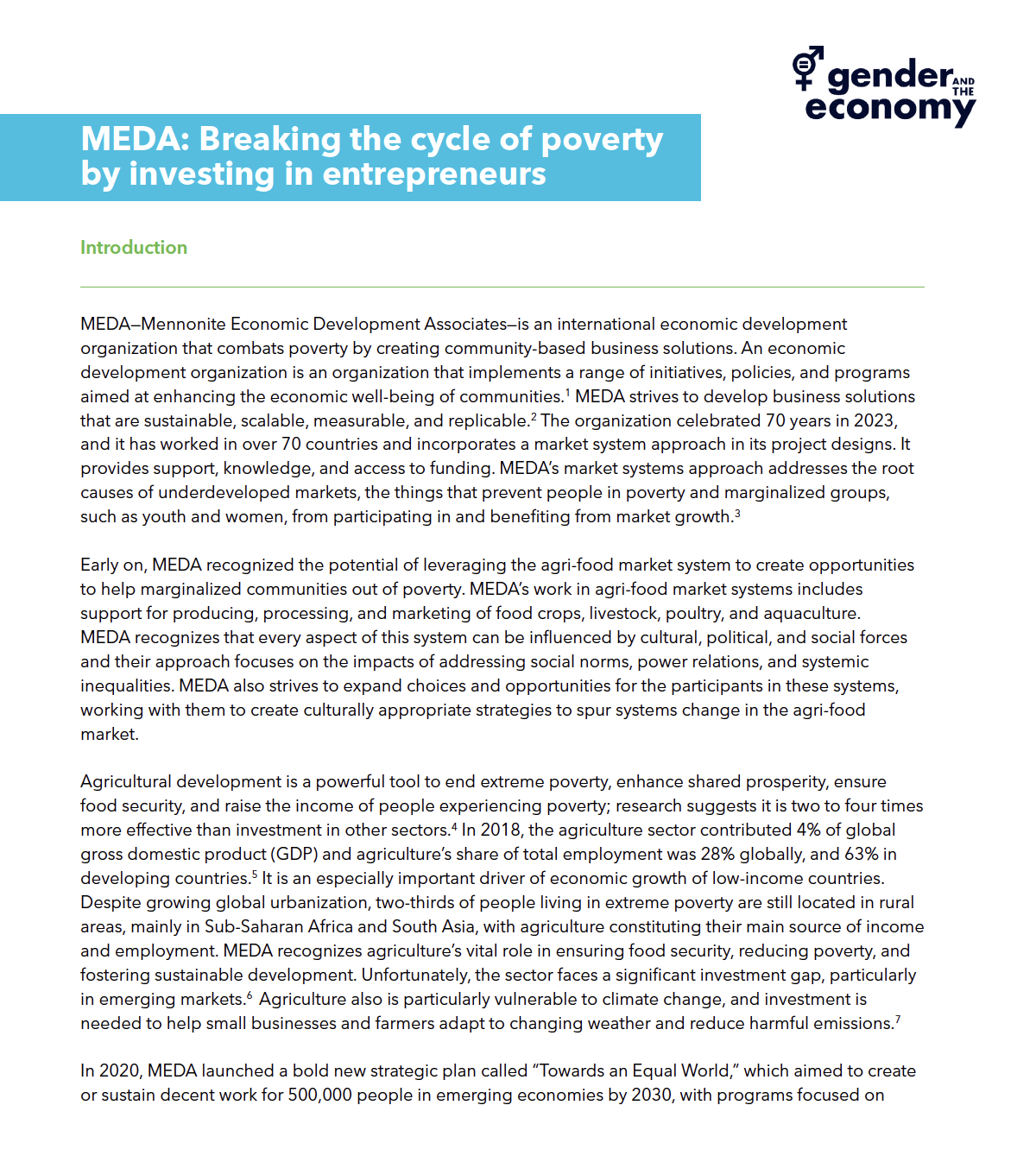
MEDA, an international economic development organization, has consistently made efforts to prioritize shared voices, taking local contexts into account to create programs that promote equity and benefit the Global South. By involving local expertise, MEDA has worked to rectify inequitable systems, cater to the needs of the local stakeholders, and deliver effective programs.
Course Topics:
Gender-based analysis
Economic development
Entrepreneurship
Agri-food businesses
Introduction
MEDA—is an international economic development organization that combats poverty by creating community-based business solutions . The organization celebrated 70 years in 2023, and it has worked in over 70 countries. MEDA incorporates a market systems approach that addresses the root causes of underdeveloped markets, especially the things that prevent people in poverty and marginalized groups, such as youth and women, from participating in and benefiting from market growth.
Early on, MEDA recognized the potential of leveraging the agri-food market system to create opportunities to help marginalized communities out of poverty. In developing countries in particular, agricultural development is a powerful tool to end extreme poverty. MEDA has been at the forefront of providing ongoing support for producing, processing, and marketing of food crops, livestock, poultry, and aquaculture. MEDA’s approach acknowledges that every aspect of the business system can be influenced by cultural, political, and social forces and their approach focuses on the impacts of addressing social norms, power relations, and systemic inequalities. MEDA also strives to expand choices and opportunities for the participants in these systems, working with them to create culturally appropriate strategies to spur systems change in the agri-food market.
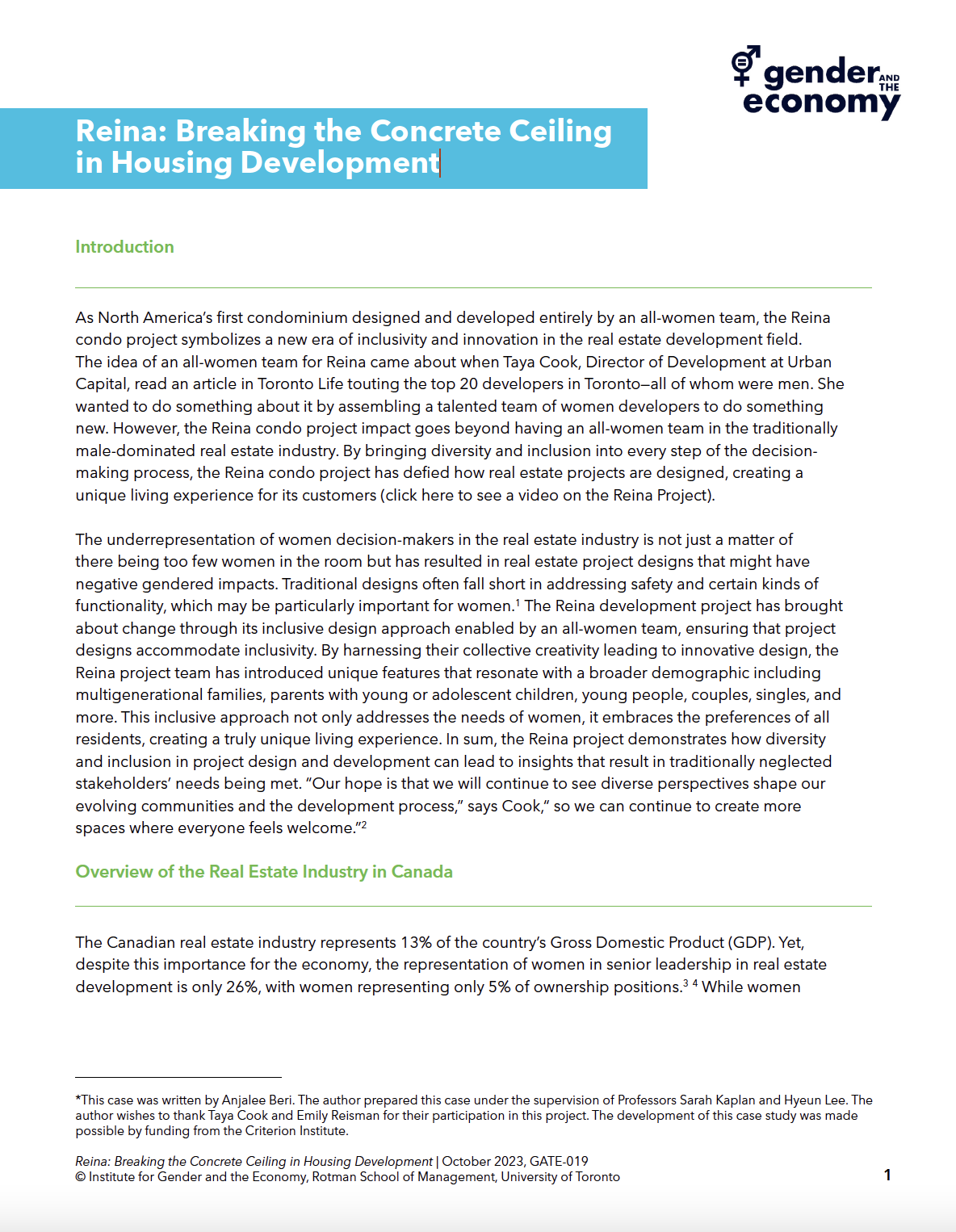
The underrepresentation of women decision-makers in the real estate industry has resulted in real estate project designs that may have negative gendered impacts or may not serve all communities well. By bringing diversity and inclusion into every step of the decision-making process, the Reina condo project has reinvented how real estate projects are designed, creating a unique living experience for its customers.
Course Topics:
Real estate
Business design
Diversity and inclusion
Gender analysis
Leadership
Introduction
As North America’s first condominium designed and developed entirely by an all-women team, Reina signifies a new era of inclusivity and innovation in the real estate development field. The concept of an all-women team for the Reina project came about when Taya Cook, Director of Development at Urban Capital, read an article in Toronto Life touting the top 20 developers in Toronto—all of whom were men. She wanted to do something about it by assembling a talented team of women developers, planners and designers to do something new.
The Reina condo project has brought about change through its inclusive design approach enabled by its all-women team, ensuring that the project design accommodates inclusivity. By incorporating lessons and insights from community engagement, the Reina project team has introduced unique features that resonate with a broader demographic including multigenerational families, parents with young or adolescent children, young people, couples, singles, and more. This inclusive approach not only addresses the needs of women, it embraces the preferences of all residents, creating a truly unique living experience. In sum, the Reina project demonstrates how diversity and inclusion in project design and development can lead to insights that result in traditionally neglected stakeholders’ needs being met.
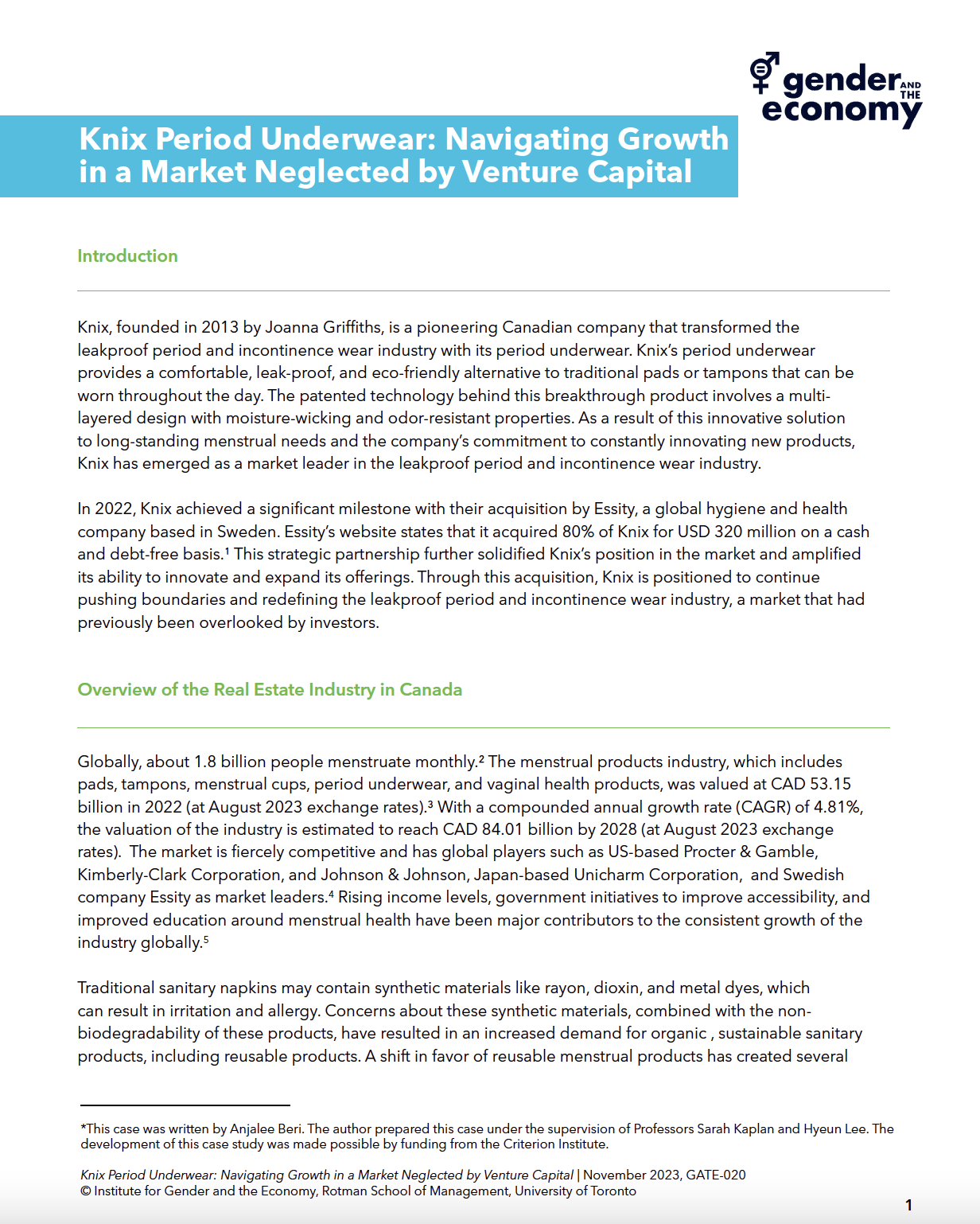
This case study examines how Knix has been able to redefine the menstrual products industry and establish leadership in leakproof period and incontinence wear. Knix’s success urges us to examine how the shift towards a more inclusive, adaptive business model and the innovation of products that truly resonate with the customer base can build new market opportunities.
Course Topics:
Gender-based analysis
Entrepreneurship
Product innovation
Venture finance
Introduction
Knix, founded in 2013 by Joanna Griffiths, is a pioneering Canadian company that transformed the leakproof period and incontinence wear industry with its period underwear. Knix’s period underwear provides a comfortable, leak-proof, and eco-friendly alternative to traditional pads or tampons that can be worn throughout the day. The patented technology behind this breakthrough product involves a multi-layered design with moisture-wicking and odor-resistant properties. As a result of this innovative solution to long-standing menstrual needs and the company’s commitment to constantly innovating new products, Knix has emerged as a market leader in the leakproof period and incontinence wear industry.
In 2022, Knix achieved a significant milestone with their acquisition by Essity, a global hygiene and health company based in Sweden. for USD 320 million (for 80% ownership). This strategic partnership further solidified Knix’s position in the market and amplified its ability to innovate and expand its offerings while also demonstrating the economic value of paying attention to markets that have been neglected by large consumer companies.
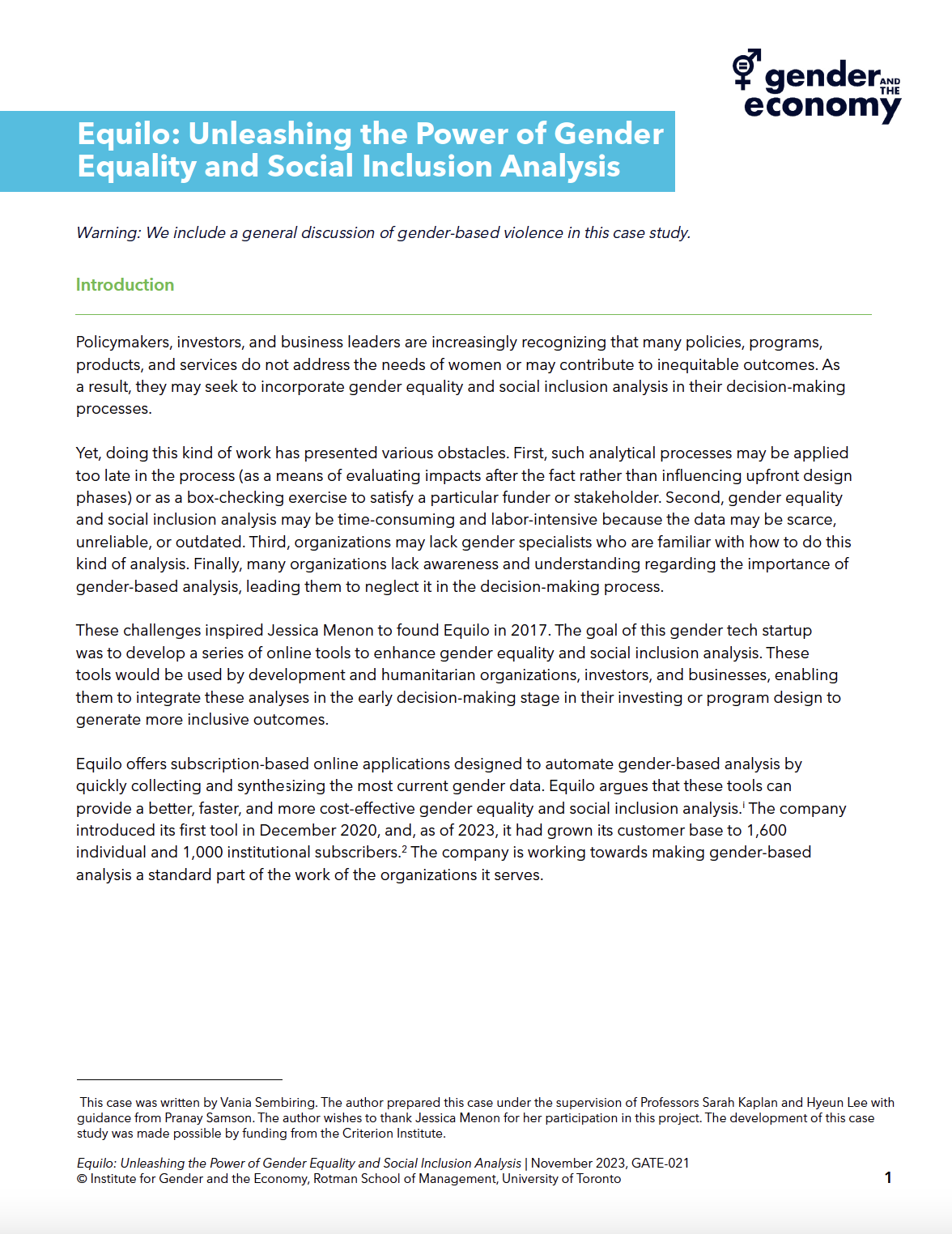
There is an increasing awareness of the importance of gender equality and social inclusion analysis among policy makers, investors, and business leaders. However, due to the lack of organizational and individual resources, these analyses have often been sidelined. Equilo is a startup working to develop accessible, user-friendly tools to address and overcome these challenges. By enabling users to accelerate the use of gender equality and social inclusion analysis in their decision-making, Equilo is aiming to make a system-level impact and contribute to creating a more just world.
Course Topics:
Gender analysis
Gender lens investing
Strategy
Social enterprise
Introduction
Having observed various challenges associated with conducting gender equality and social inclusion analysis, Jessica Menon founded Equilo in 2017. The goal of this gender tech startup, which is a social enterprise, was to develop a series of online tools to enhance gender equality and social inclusion analysis. These tools would be used by development and humanitarian organizations, investors, and businesses, enabling them to integrate these analyses in the early decision-making stage in their investing or program design, aiming to generate more inclusive outcomes.
Equilo offers subscription-based online applications designed to automate gender-based analysis by quickly collecting and synthesizing the most current gender data. Equilo argues that these tools can offer a better, faster, and more cost-effective gender equality and social inclusion analysis. The company introduced its first tool in December 2020, and, as of 2023, it had grown its customer base to 1,600 individual and 1,000 institutional subscribers. The company is working towards making gender-based analysis a standard part of the work of the organizations it serves.
This case was written by Vania Sembiring. The author prepared this case under the supervision of Professors Sarah Kaplan and Hyeun Lee with guidance from Pranay Samson.
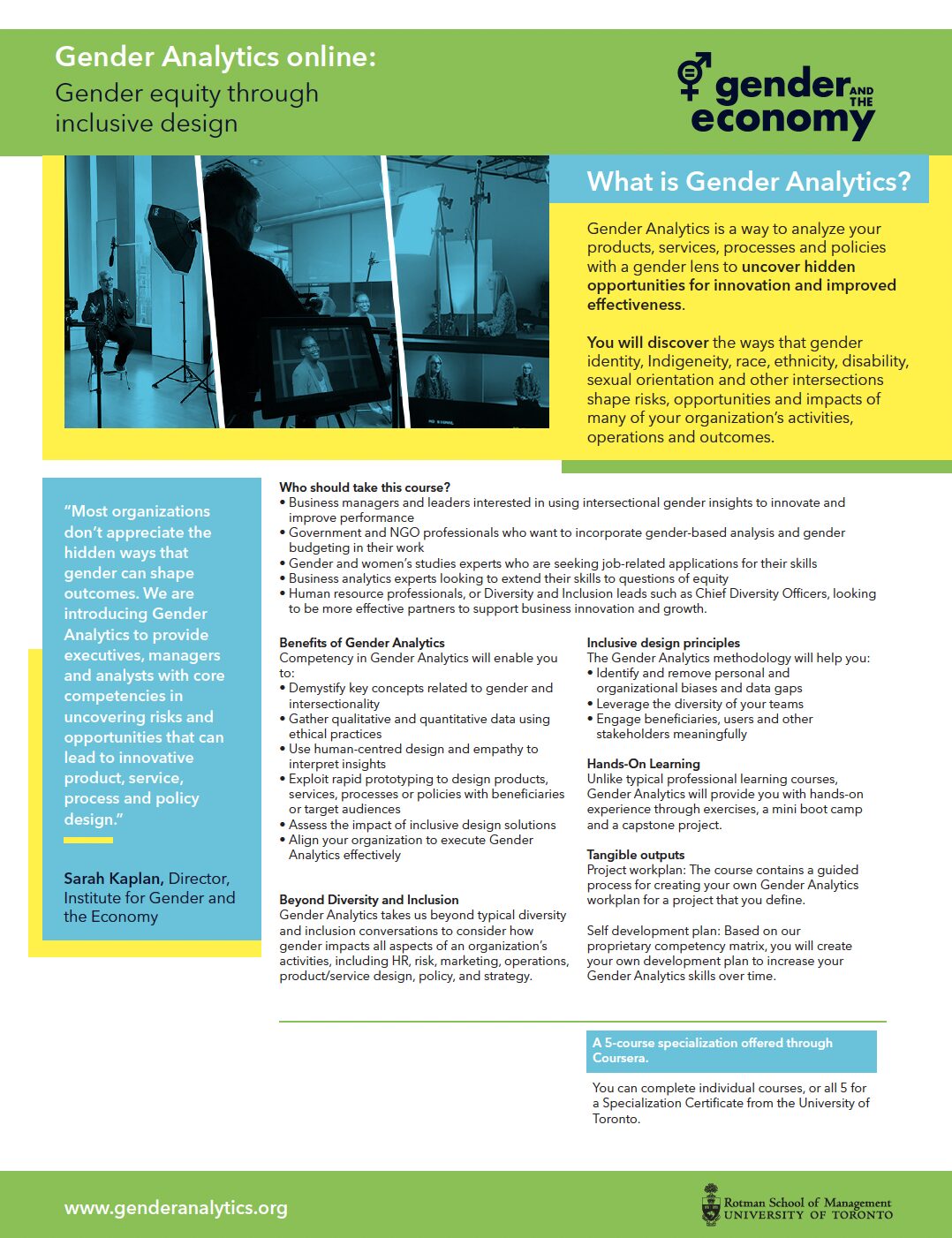
Our 5 course specialization on Coursera will help you learn how to use Gender Analytics to create more equitable impact!
What is Gender Analytics?
Gender Analytics is a way to analyze your products, services, processes and policies with a gender lens to uncover hidden opportunities for innovation and improved effectiveness. You will discover the ways that gender identity, Indigeneity, race, ethnicity, disability, sexual orientation and other intersections shape risks, opportunities and impacts of many of your organization’s activities, operations, and outcomes.
Business managers and leaders interested in using intersectional gender insights to innovate and improve performance
Government and NGO professionals who want to incorporate gender-based analysis and gender budgeting in their work
Gender and women’s studies experts who are seeking job-related applications for their skills
Business analytics experts looking to extend their skills to questions of equity
Human resource professionals, or Diversity and Inclusion leads such as Chief Diversity Officers, looking to be more effective partners to support business innovation and growth.
Benefits of Gender Analytics
COMPETENCY IN GENDER ANALYTICS WILL ENABLE YOU TO:
Demystify key concepts related to gender and intersectionality
Gather qualitative and quantitative data using ethical practices
Use human-centred design and empathy to interpret insights
Exploit rapid prototyping to design products, services, processes or policies with beneficiaries or target audiences
Assess the impact of inclusive design solutions
Align your organization to execute Gender Analytics effectively
Gender Analytics takes us beyond typical diversity and inclusion conversations to consider how gender impacts all aspects of an organization’s activities, including HR, risk, marketing, operations, product/service design, policy, and strategy.
Unlike typical professional learning courses, Gender Analytics will provide you with hands-on experience in doing Gender Analytics including a hackathon for experiential learning-by-doing
Project workplan: The course contains a guided process for creating your own Gender Analytics workplan for a project that you define. Personal development plan: Based on our proprietary competency matrix, you will create your own development plan to increase your Gender Analytics skills over time
ACKNOWLEDGEMENTS: THE GENDER ANALYTICS SPECIALIZATION WAS DEVELOPED BY THE INSTITUTE FOR GENDER AND THE ECONOMY AT THE UNIVERSITY OF TORONTO’S ROTMAN SCHOOL OF MANAGEMENT WITH SUPPORT FROM CIBC, CATALYST, INC., PWC, AND WOMEN AND GENDER EQUALITY CANADA.
For more information on the courses and modules, see our brochure.
About the series: Business leaders and policy makers often fail to consider how their policies, products, services and processes can have impacts on inequality. To think about how to unlock innovative opportunities using an intersectional gender lens, GATE joined with our Rotman partner, the TD Management and Data Analytics lab, to host a one-day conference in the Spring of 2023 called “Gender Analytics: Possibilities” (or GAP). This podcast shares exciting panel conversations from the conference on topics like decolonizing data and design, inclusive government policy, responsible AI, and more.
*Disclaimer: The opinions expressed in this series do not necessarily reflect the views of the Institute for Gender and the Economy or the University of Toronto.